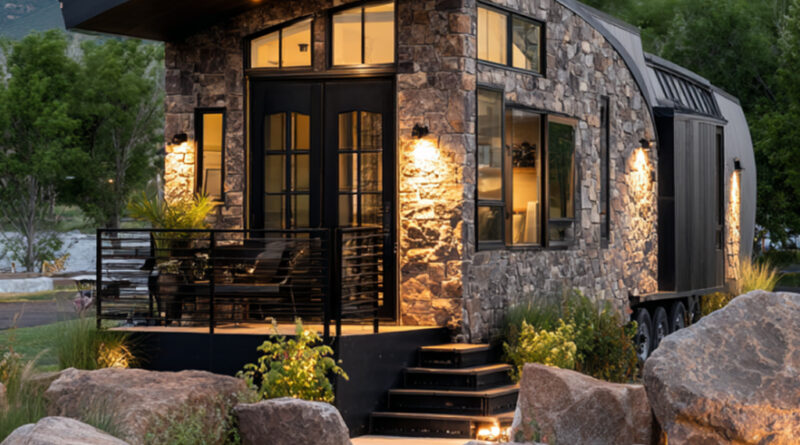
A Modern Tiny House That Redefines Compact Living
Most tiny houses try too hard. They either overload the design with trendy details or strip everything down until it feels lifeless. This one avoids both mistakes, and that’s exactly why it stands out. At first glance, the exterior already sets a different tone. The curved roofline breaks away from the predictable box shape that dominates the tiny house world, giving the structure a sense of movement and identity. It doesn’t look temporary or improvised—it feels intentional. The combination of natural stone and dark metal reinforces that impression, grounding the house into its surroundings while still keeping a modern edge. As the evening light hits the façade, the warm glow from the fixtures transforms the entire structure into something far more premium than its size would suggest.
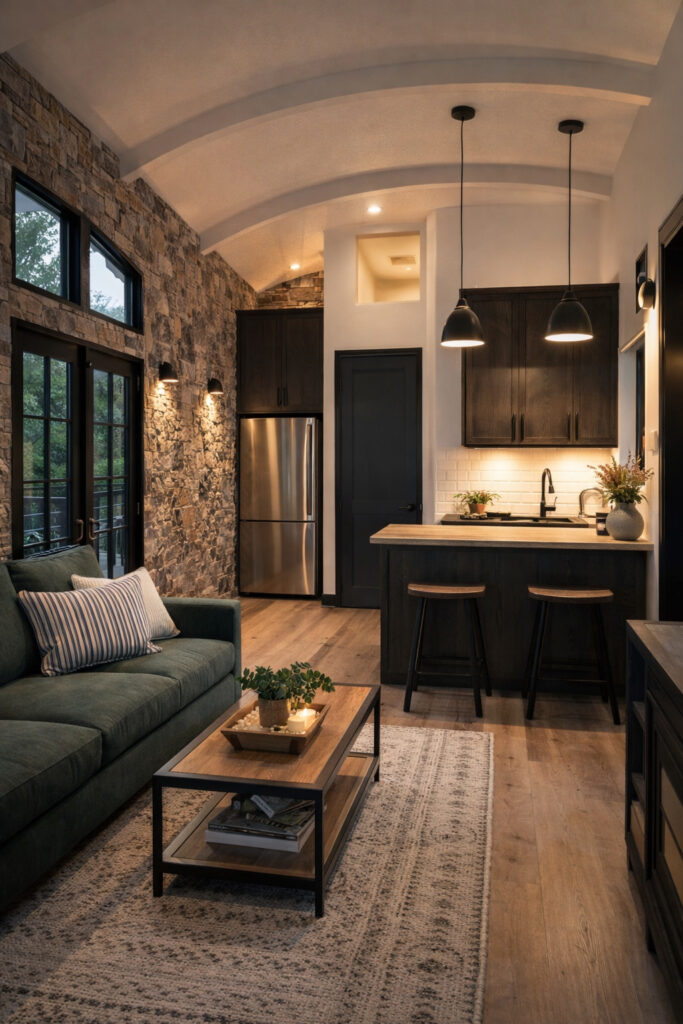
But the real strength of this home isn’t just how it looks—it’s how controlled everything feels. Step inside, and the space immediately opens up, not because it’s large, but because it’s designed with restraint. The vaulted ceiling plays a crucial role here, pulling the eye upward and creating a sense of volume that most tiny homes completely miss. Instead of cluttering the interior with unnecessary elements, the design leans into a clean composition where every material has a purpose. The stone wall continues inside, creating continuity with the exterior and preventing that disconnected feeling many small homes suffer from. Dark cabinetry contrasts with warm wooden tones, adding depth without overwhelming the space.
Nothing feels random, and that’s rare.
The living area flows seamlessly into the kitchen, forming a compact but highly functional environment. It’s not trying to impress with excess—it’s built to feel balanced. The lighting, in particular, does more work than most people realize. Soft, layered illumination creates warmth and dimension, turning what could have been a tight space into something genuinely inviting.
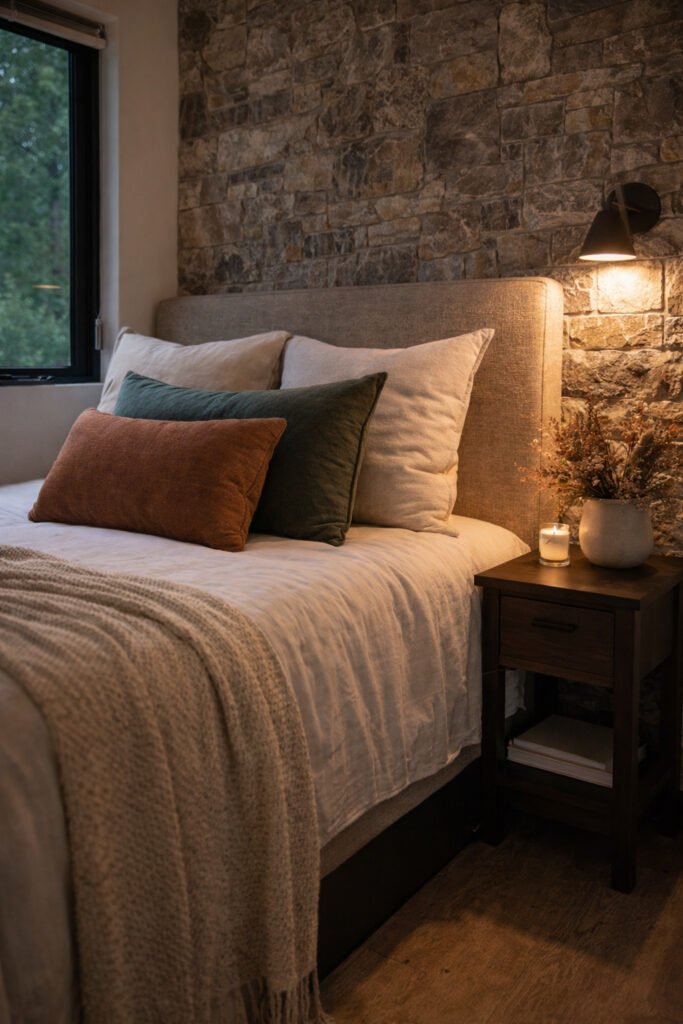
The same discipline carries into the bedroom, where simplicity becomes the strongest feature.
There’s no attempt to overdesign or fill every corner. Instead, the room focuses on comfort through texture and tone. Soft fabrics, neutral colors, and warm lighting create a calm atmosphere that feels intentional rather than empty. It’s a reminder that small spaces don’t need more objects—they need better decisions.
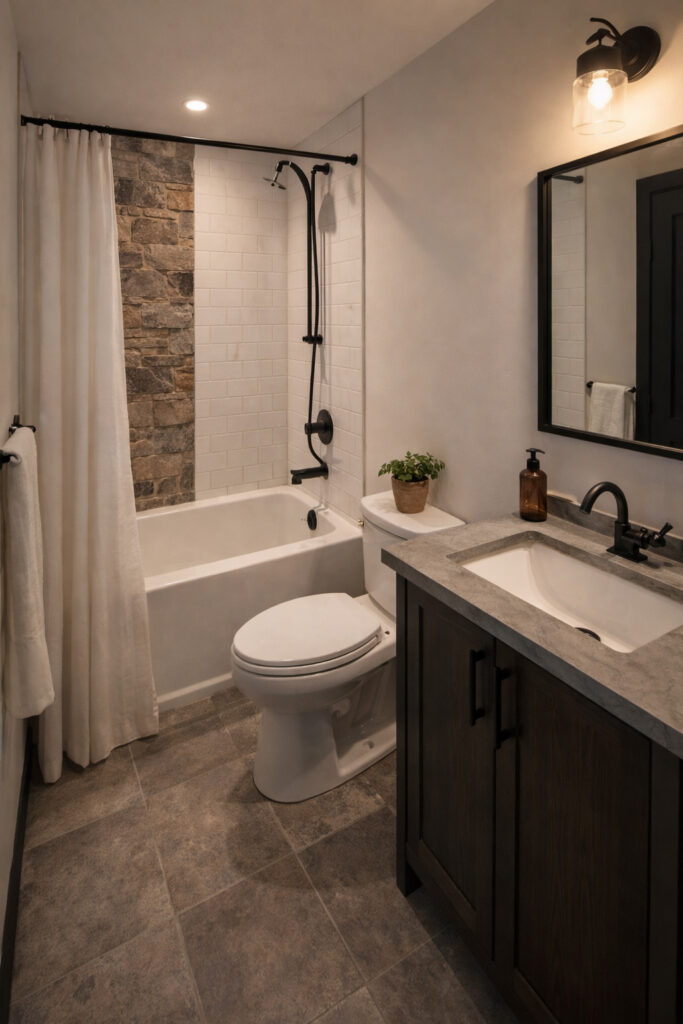
Even the bathroom, often the weakest part of a tiny house, holds the same level of consistency.
The layout is efficient without feeling cramped, and the material palette stays aligned with the rest of the home. Light surfaces keep the space open, while darker accents add contrast and definition. It doesn’t rely on gimmicks or unnecessary features—just solid, functional design executed properly.
In the end, what makes this tiny house work isn’t creativity alone. It’s control.
Every element, from the architecture to the smallest interior detail, follows a clear direction. Nothing is added just for the sake of filling space, and nothing feels out of place. That level of discipline is what separates a forgettable design from one that actually leaves an impression.
And that’s the part most people get wrong.