She Bought a Worn Airport Shuttle for $3,200—At Night, the Ceiling Becomes Her Bedroom
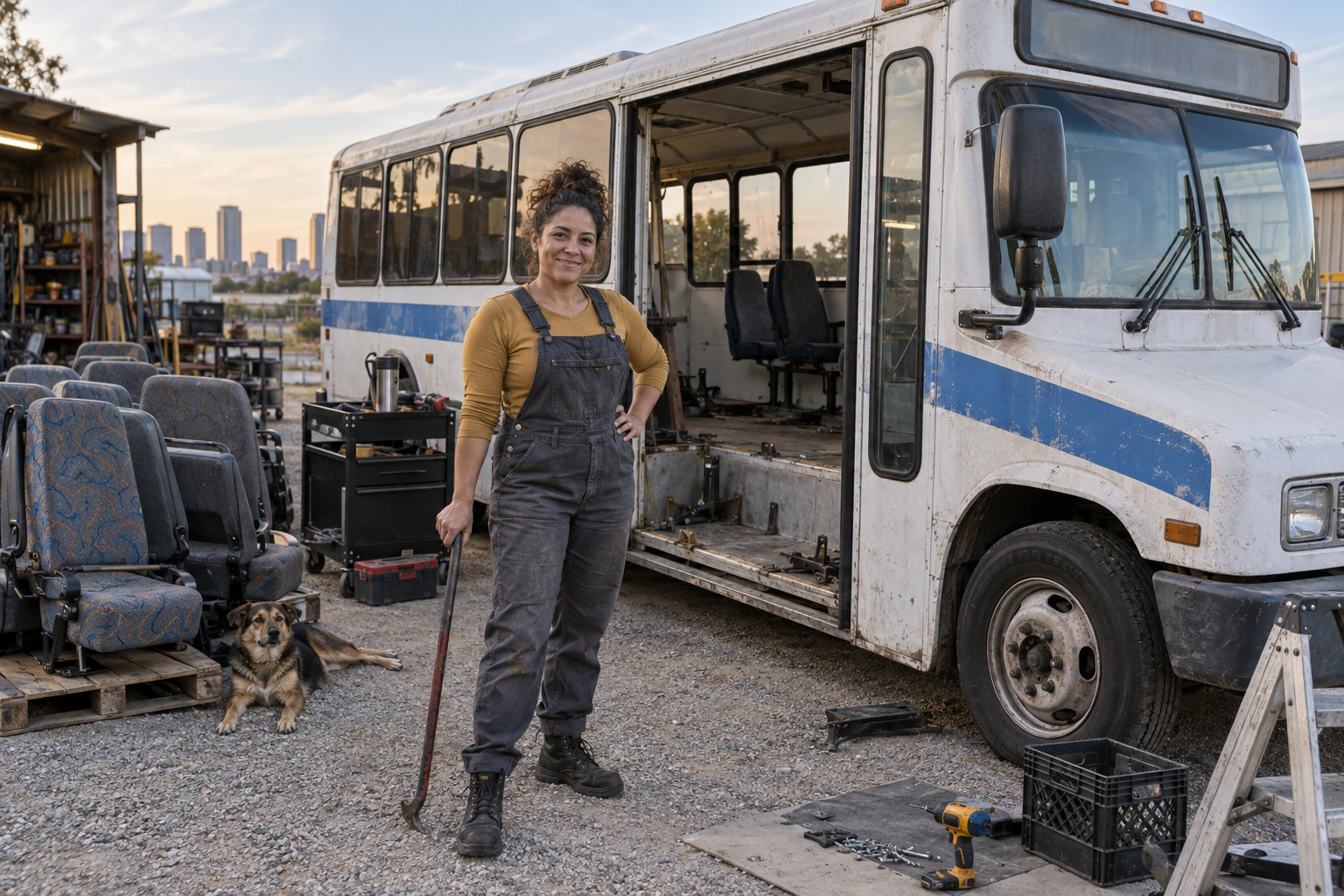
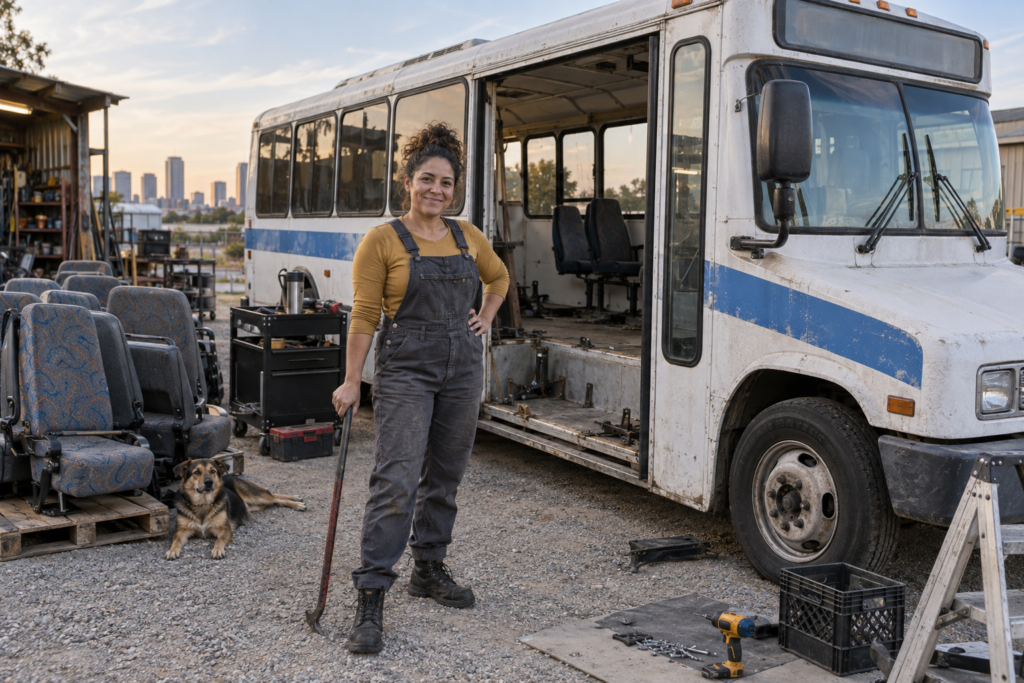
When Nina Torres bought a retired airport shuttle for $3,200, it still smelled faintly of vinyl seats and industrial cleaner.
The 26-foot bus had carried travelers between terminals for nearly two decades. Its engine ran, its wide entry door worked, and 21 patterned passenger seats were bolted to a floor coated with old gum and luggage-wheel marks.
Nina, a 38-year-old night-shift paramedic, did not see public transportation. She saw tall windows, a strong flat floor and enough headroom for an idea she had sketched during quiet hours at the station.
Her plan kept a real queen bed without surrendering the rear half of the bus.
The bedroom would spend each day on the ceiling.
The bus was cheap because its problems were expensive
The shuttle had 286,000 miles, aging tires and an air-conditioning system that only worked occasionally. Before buying it, Nina paid a diesel mechanic for a full inspection.
The engine and transmission were serviceable, but deferred maintenance added $4,700 before the conversion began. Nina replaced hoses, brakes, fluids and two tires. She also removed redundant airport electronics and sealed openings left by old signage.
The inspection changed her budget, not her decision.
Unlike a full-size school bus, the shuttle was short enough for the parking pad she had leased. Its interior width could hold standard cabinets, and the original passenger air-conditioning channels created useful routes for new wiring.
Nina removed the seats herself over three weekends. She sold twelve to a small theater, recycled the steel bases and kept two frames for workshop chairs.
A fixed bedroom made the home feel like a hallway
Nina’s first layout placed a queen bed across the rear. It fit, but the mattress dominated everything behind the kitchen. The only seating was a narrow bench, and there was no place to eat with another person.
A sofa bed saved space but required rearranging cushions after every 12-hour shift. A loft was impossible because the bus ceiling was too low.
Nina found the answer in equipment used inside toy-hauler trailers: a guided lift platform that raises a bed vertically when it is not needed.
She redesigned the rear as a U-shaped lounge with a dining table. Above it, a lightweight aluminum queen-bed frame travels on four synchronized lift posts.
During the day, the mattress rests 11 inches below the ceiling. At night, it lowers to sleeping height above the seat cushions.
The same part of the bus became two complete rooms.
Safety mattered more than the dramatic reveal
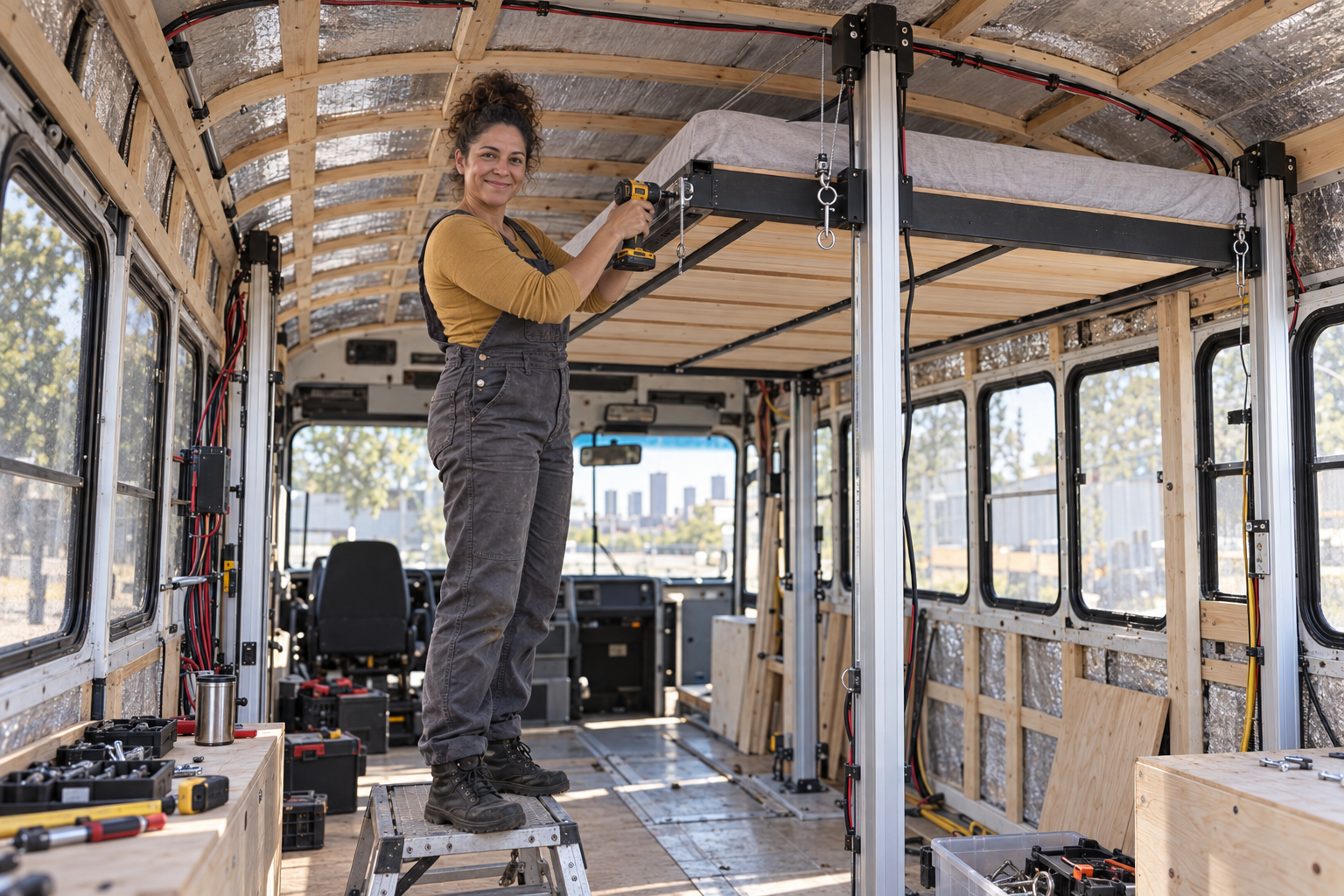
Nina hired a fabricator to attach the four lift posts to reinforced sections of the bus frame. The bed is raised by paired cables connected to a compact 12-volt winch, but the motor does not hold its weight.
Mechanical locking pins support the platform in both positions. Limit switches stop travel automatically, and an emergency hand crank can move the bed if power fails.
Nina also installed a pressure-sensitive strip beneath the frame. If the bed encounters an obstruction, it stops.
“It looks like the clever part is making the bed move,” she said. “The clever part is making sure it cannot move when it shouldn’t.”
The mattress stays made as the platform rises. Slim safety rails fold against the frame, while reading lights and charging ports travel with the bed on a flexible wiring loom.
The finished bus feels like a small apartment
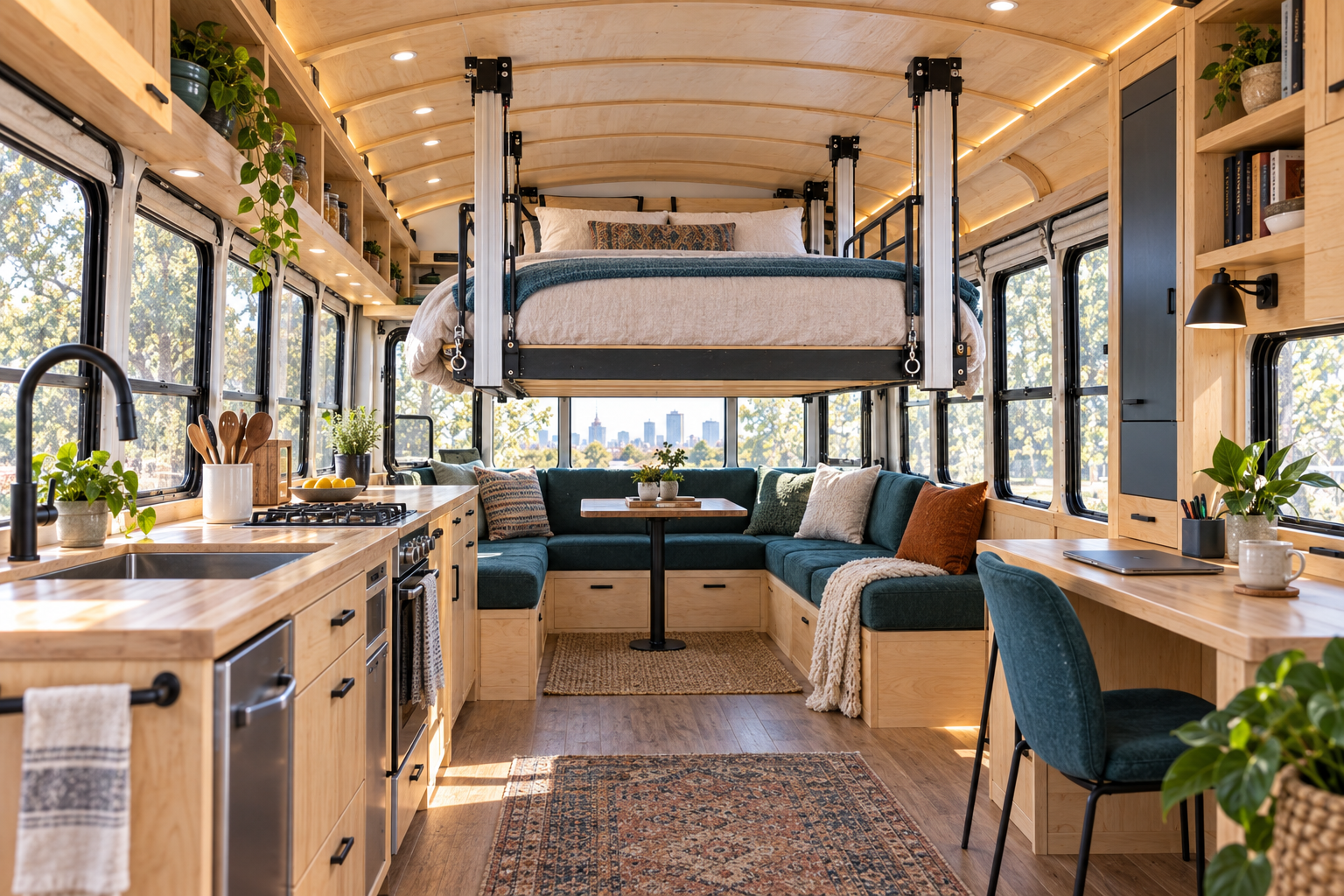
Nina used pale maple cabinetry and deep teal upholstery to keep the long interior bright without making it feel sterile. The original bus windows remain, fitted with insulated magnetic shades for nights and hot weather.
The galley occupies the driver’s side, with a deep sink, induction burner, refrigerator drawers and a compact oven. Across the aisle, a desk faces a window and doubles as additional counter space.
The bathroom sits behind the driver’s compartment. It contains a tiled shower, compact toilet and narrow wardrobe. Water tanks are mounted low between the frame rails to preserve balance.
At the rear, the lounge seats five around a removable table. Storage drawers fill the seat bases. When the bed lowers, the table pedestal releases and the mattress stops above the cushions at ordinary bed height.
Nina can lower it in 38 seconds.
What the conversion cost
The completed project cost $52,940, excluding the parking pad.
| Category | Cost |
|---|---|
| Retired airport shuttle | $3,200 |
| Mechanical repairs and tires | $4,700 |
| Insulation, floor and interior shell | $6,480 |
| Electrical and solar system | $8,260 |
| Plumbing and water storage | $5,340 |
| Kitchen and appliances | $6,190 |
| Bathroom | $4,280 |
| Ceiling-bed lift and reinforcement | $7,650 |
| Cabinetry and furniture | $5,510 |
| Registration and miscellaneous | $1,330 |
| Total | $52,940 |
The lift bed was the most expensive single interior feature. Nina could have saved thousands with a fixed mattress, but that would have removed the lounge she uses every day.
She completed painting, cabinetry and insulation herself. Certified professionals handled the lift reinforcement, high-voltage electrical work and propane-free heating system.
The home fits around an unusual schedule

Nina returns from work shortly after sunrise. She closes the insulated shades, lowers the bed and sleeps while the rear lounge disappears beneath her.
In the afternoon, the mattress rises and the room becomes a place to eat, stretch and read. She does not have to fold bedding, rebuild a sofa or climb a ladder while tired.
The bus is parked on a permitted long-term pad with electrical service, water and waste connection. Nina still keeps the vehicle registered and roadworthy, although she moves it rarely.
Her biggest surprise was not how small the home feels, but how quickly its purpose changes.
“At work, every square foot has to do more than one job,” she said. “I think I brought that way of thinking home.”
From outside, the shuttle still resembles the vehicle that once circled an airport. The blank destination sign and wide windshield remain. Only the cedar door and teal paint hint at the changes within.
Inside, a queen bedroom waits overhead—out of sight until Nina presses the switch and the ceiling slowly comes down.